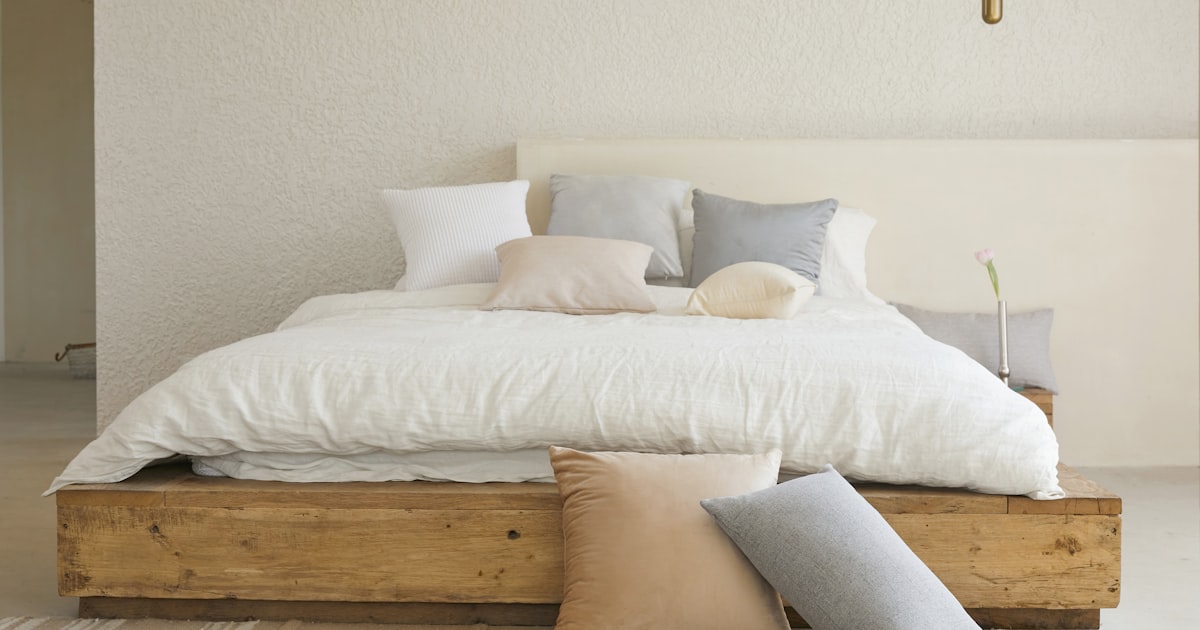
Put your bed where you can see the door without being lined up with it, and where the wall behind your headboard is solid, not a window. That single arrangement, called the command position, matters more than any other bedroom decision. Once you have it, your personal Kua number tells you which way to point your head for the biggest additional benefit.
Most people put their bed wherever it fits. Against the longest wall, or wherever the last tenant left it. The spot changes how safe and how rested you feel every night, and it works the same way whether you own the house, rent the room, or are staying somewhere for six months.
The command position, in any room
Imagine lying in bed. You want three things. A solid wall behind your headboard, not a window or a half wall. A clear view of the bedroom door, not staring at it, just able to glance over. Your bed not lined up directly with the doorway, slightly off to one side.
It is the same instinct that makes most people choose the restaurant seat with its back to the wall, facing the room. Your bed should work the same way. Within the first few nights in this position, most people notice they fall asleep faster and toss less. That is not mysticism. It is your nervous system finally getting to relax because nothing can surprise it from behind.
Positions to avoid
Feet pointing straight at the door. Traditionally called the coffin position. Air and movement run straight up the length of your body, and you are in the most exposed spot in the room.
Headboard against a window. Behind your head should feel solid, not like something could come through it. If this is your only option, a tall headboard and heavy curtains help. Keep the windowsill higher than the top of the headboard.
Back to the door. If you cannot see the door at all, part of you stays slightly alert even if you never consciously notice it.
Under a beam or a sloped ceiling. Beams create a pressing feeling overhead. Position the bed so no beam cuts directly across it, or paint the beam the same color as the ceiling to reduce the effect.
Same wall as the door. When someone opens the door, the first thing they should not see is the side of your bed.
When your room will not give you all three
Most rooms do not. Windows on two walls, a door in an awkward spot, or simply not enough space. When you cannot get all three at once, here is the order that matters.
First, the solid wall behind your head. This is the one to protect above everything else. Second, avoid the coffin position. If you cannot avoid your feet pointing at the door, a low piece of furniture at the foot of the bed breaks the direct line. Third, see the door. A small mirror placed so you can see the entrance from bed, without seeing your own reflection, is a common workaround.
Getting seventy percent of this right still makes a real difference. A room does not need to be perfect.
Your four best sleeping directions, and how to find yours
The command position is universal. It works the same for everyone in every room. What is personal is which way your head points once the command position is satisfied, and that comes from your Kua number, a single digit calculated from your exact birth date and gender.
Everyone falls into one of two groups. East Group people have four favorable directions clustered around east, southeast, south and north. West Group people have four clustered around west, northwest, southwest and northeast. Within your group, the four directions are ranked: one supports prosperity, one supports health, one supports relationships, and one supports general stability.
The calculation depends on the exact date, not just the year. The Chinese solar year turns on February 4, not January 1, so two people born three weeks apart in the same January can land in opposite groups entirely. That is not a small rounding error. It flips all four of their directions.
You can get your own number, calculated correctly against the solar cutoff, with the Kua number calculator. Enter your birth date and gender and it returns your number, your group, and your four directions in about a second.
Once you have your direction, apply it only after the command position is already satisfied. If your best direction means facing a window with your feet toward the door, skip it. A safe, grounded position in your third-best direction beats a technically ideal direction in a bad spot, every time.
Bed placement for couples versus one person
If two people share the bed, both need to get in and out from their own side, so the bed cannot be pushed against a wall on either edge. Matching nightstands and lamps, not necessarily identical, just similar in visual weight, reinforce that the room belongs to both people equally.
If you sleep alone, pushing the bed into a corner with one side against the wall is fine and saves space. If your Kua directions differ from a partner's, that is common, and the resolution is the same principle as above: protect the command position for both of you first, then split the difference on direction, then give priority to whichever of you has the harder time sleeping.
Beams, slopes, and odd angles
Never sleep with a beam running across the width of the bed. Position the bed so beams run lengthwise instead, or so the bed sits between them. On a sloped ceiling, place the headboard at the tallest point of the slope. On an angled wall, do not push the headboard against a surface that leans away from you. Find the most solid, straight wall section in the room and start there.
The short version
Solid wall behind you, door in view, not lined up with the doorway. That order never changes. Once it is satisfied, your Kua number tells you which of the remaining good spots is best for you specifically.
Your Kua number also carries into other rooms, particularly where you work. See feng shui home office desk placement for how the same direction applies at your desk.
Frequently asked questions
What is the best feng shui bed position?
A solid wall behind the headboard, a clear view of the bedroom door, and the bed not lined up directly with the doorway. This is called the command position and it applies in every room, regardless of which direction the bed faces.
Does the direction my head points really matter?
It is a secondary factor to the command position, but it is a real one, and it is personal rather than universal. Your ideal direction comes from your Kua number, calculated from your exact birth date and gender.
What if my ideal direction puts my bed under a window?
Skip it. The command position always outranks compass direction. A safe, grounded position in your second or third best direction beats a technically ideal direction in a bad spot.
My partner and I sleep facing different directions. Is that a problem?
It is common and not something to lose sleep over, so to speak. Protect the command position for both people first. If your directions genuinely conflict, prioritize whoever has more trouble sleeping and let the other person use their direction at a desk or reading chair instead.
How do I find my Kua number?
You need your exact birth date and gender, because the Chinese solar year turns on February 4, not January 1, and using the wrong year can flip your whole result. The [Kua number calculator](/tools/kua-number-calculator) handles the date correctly and gives you your number and your four directions in seconds.