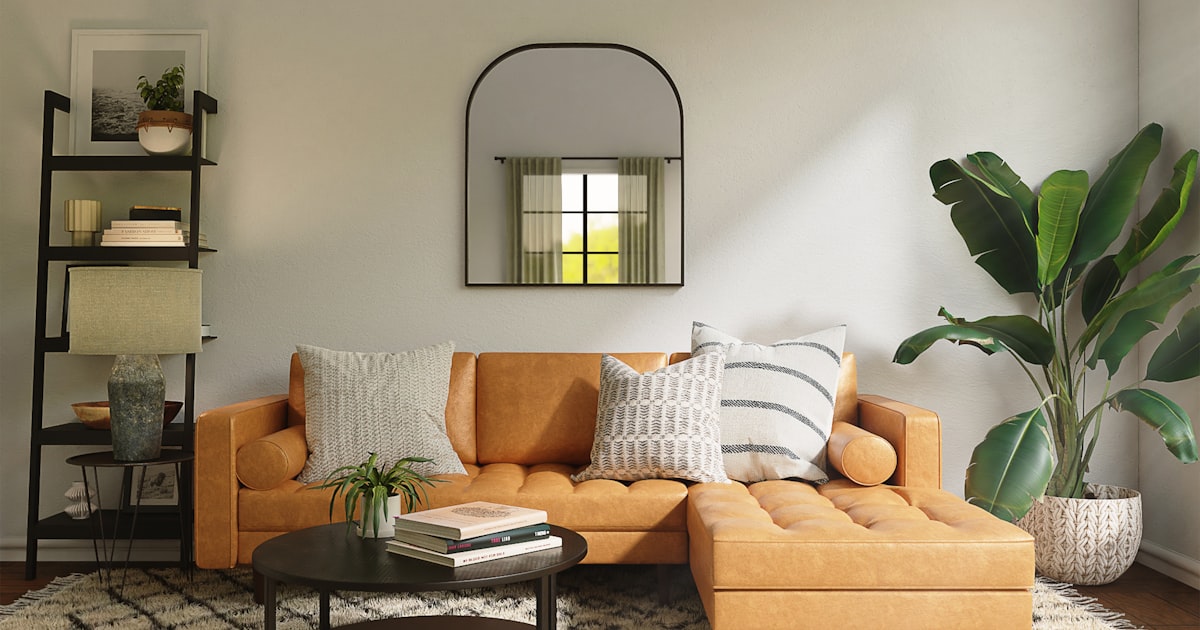
Most people place their couch based on where the television goes, not where it actually feels good to sit. The same command position that applies to a bed applies here: a solid wall behind the main seat, a view of the room's entrance, not lined up with the doorway.
Primary Keyword: feng shui couch placement
Meta Description: Where you put your couch changes how your living room feels. Here is exactly how to find the best spot using feng shui principles.
Your couch is probably the most-used piece of furniture in your home. But most people place it based on where the TV is, not where it actually feels good to sit. That distinction matters more than you might think.
The Command Position Works for Couches Too
The same principle that applies to your bed placement works for your couch. Your main seating position should have a solid wall behind it, a view of the room's entrance, and not be directly in line with the door. If you have heard the restaurant analogy before, here it is again, and here is why it matters. When you sit on your couch and cannot see who walks in, you are subtly on alert. You cannot read a book or have a conversation properly if part of your brain is monitoring the room behind you.
Your body knows when it is exposed. The tension is not dramatic, but it is persistent. Over weeks and months, you end up spending less time in a living room that does not feel right, and you cannot quite explain why. It is not that the room is ugly. It is that the setup does not let you actually relax. You have probably experienced this at other people's homes or in hotel lobbies. Some waiting areas feel fine because the seating is arranged well. Others feel off, and you find yourself fidgeting or wanting to leave, even though there is nothing objectively wrong with the furniture.
Think about your own couch. How do you feel sitting there? Can you watch the door while scrolling on your phone? Do you ever feel like someone could walk up behind you? When you have guests over, do people naturally stay and chat, or do they seem uncomfortable and keep standing? These are not coincidences.
The TV Trap
Most people arrange the entire living room around the TV. The couch faces the screen, and everything else orbits around it. The problem is that TVs are usually placed against the most convenient wall, which often puts your couch in a bad position: back to the door, floating in the middle of the room, or pushed against a window where light washes out whatever you are trying to watch anyway. This happens because TV placement feels more fixed and harder to change, so everything else adapts to it.
Here is the better approach. Find the command position for your couch first. That means identifying where you can sit with a solid wall behind you and a view of the door. Then figure out where the TV goes from there. A wall-mounted TV is easier to reposition than a couch. You have the option to mount it on a side wall, on an angle, or even remove it temporarily if you are entertaining. You can even lean a TV on a stand instead of mounting it. A couch that is badly positioned stays badly positioned for years.
Most people do not actually sit and watch TV for most of their time in the living room. They sit, talk, read, work on laptops, and scroll through phones. The couch needs to work for those activities first. The TV is secondary. If you really want to optimize for TV watching and cannot bear to move things around, consider a tilting mount that lets you angle the screen rather than moving the couch.
L-Shapes, Sectionals, and Multiple Seats
L-shaped sofas naturally create a protected corner, which is psychologically comforting. The open end of the L should face toward the room entrance if possible. This way, the corner gives you support, and you can still see into the room. The person sitting in the corner of the L has the strongest position, with walls on two sides and a view of the room. This is naturally where you would sit to relax deeply.
If you have separate chairs and a sofa, the main sofa gets the command position. Additional seats fill in around it. Avoid having all seating face the same direction, like a theater layout. Conversation arrangements, where seats face each other at least partially, create better energy flow. People feel more inclined to actually talk and connect instead of sitting in parallel, staring straight ahead. You can have a comfortable conversation across a coffee table. You cannot easily do it if everyone is looking forward.
A sectional pushed against two walls with an open side facing the room also works well, especially in smaller apartments. The key is that someone sitting on the main seat has a solid back and a view outward. Even in tiny studios, you can arrange a small couch and chair to follow these principles.
What to Put Behind Your Couch
A solid wall is ideal. If your couch floats in the room because you have an open-plan layout, place a console table behind it to create a symbolic wall. A tall plant behind a floating couch also works. The important thing is not to leave it completely open and exposed. The console table serves both functions: it provides visual definition and gives you something solid behind you. You could place a bookshelf, a desk, or even a decorative screen behind a floating couch.
Avoid having a walkway directly behind your couch where people pass behind you regularly. Every time someone walks past, you feel it, even if you are not consciously aware. It interrupts your sense of security. If you must have a couch that floats, at least position it so traffic flows around the sides, not directly behind you. This is more common in open-plan apartments and lofts. The solution is usually to angle the couch slightly or place it on a large area rug to define the seating zone and encourage people to walk around it rather than behind it.
Common Living Room Mistakes
Couch blocking a window entirely is one of the most common mistakes. This blocks light and restricts energy flow. Light is what makes a space feel alive. Move the couch out from the window or at least partially clear it. You do not need to have the window completely open, but people inside should see daylight.
Couch too far from other seating kills conversation and makes the room feel disconnected. People should be able to talk comfortably without shouting. A distance of six to eight feet between a couch and a facing chair is ideal. Anything further and you are no longer in the same conversation.
Couch directly facing the front door is an exposed feeling that most people sense immediately. You are the first thing anyone sees when they enter. It is fine to have the couch visible from the door, but not aimed straight at it like a target. Angling the couch slightly or placing a chair between the couch and the door helps.
Coffee table too large for the space restricts movement. You should be able to walk around it naturally. A cramped living room never feels good, no matter what else you fix. The coffee table should leave at least 18 inches on all sides for comfortable movement.
What About Feng Shui for the Rest of the Living Room
Keep the center of the room relatively open for energy to flow. You do not need a massive empty space, but the path from the entrance to the back of the room should not feel blocked. Open space allows people to move through and around the living room comfortably. This supports both practical movement and psychological ease.
Coffee table placement should not block the path between the couch and the door. Ideally, you can walk naturally from entrance to seating area. A clear path through the room also makes it feel larger than it is.
Plants in empty corners add life and fill dead space. A corner with nothing in it feels abandoned. A corner with a healthy plant feels intentional. A large plant in an empty corner transforms the feeling of the entire room.
Mirrors can work well in living rooms if positioned correctly. A mirror reflecting the view from the window, or the room entrance, expands the sense of space. Avoid having mirrors directly opposite the door, which can feel disorienting to someone walking in.
The living room is where you spend your waking hours. But the room that affects your sleep, your recovery, and your energy the next day is your bedroom. If you have not looked at your bedroom layout yet, that is the place to start.
See this for your own address
Your living room and your bedroom both benefit from the same principle. Once you have the couch sorted, see what your house's facing direction means for the rest of the home. Enter your address, free.
Frequently asked questions
Where should a couch go in a living room?
Against a solid wall, where you can see the main entrance to the room without being lined up directly with it. That is the same command position that applies to a bed or a desk, and a living room is the place people most often break it in order to face a television.
What if the only good spot faces away from the television?
Turn the television rather than the couch where you can. If the television cannot move, accept the trade and add something solid behind the couch so you are not exposed from the back. A room where you never relax is a worse outcome than a slightly awkward screen angle.
Does a couch floating in the middle of a room work?
It works if you give it a back. A console table, a low bookcase or a bench behind a floating couch supplies the support a wall would have given, and the room reads as arranged rather than unfinished.
How do sectionals and L shapes fit the rule?
Put the long side of the L against the wall and let the short side face into the room. The seat you use most should be the one with the wall behind it and the entrance in view. The other seats can be more relaxed about it.
Does any of this apply to a small living room?
Yes, and it usually gets simpler. A small room often has one workable arrangement, which means the decision makes itself. Pushing every piece of furniture against a wall to gain floor space is the common mistake, because it can leave the middle of the room empty and the seating strangely far apart.