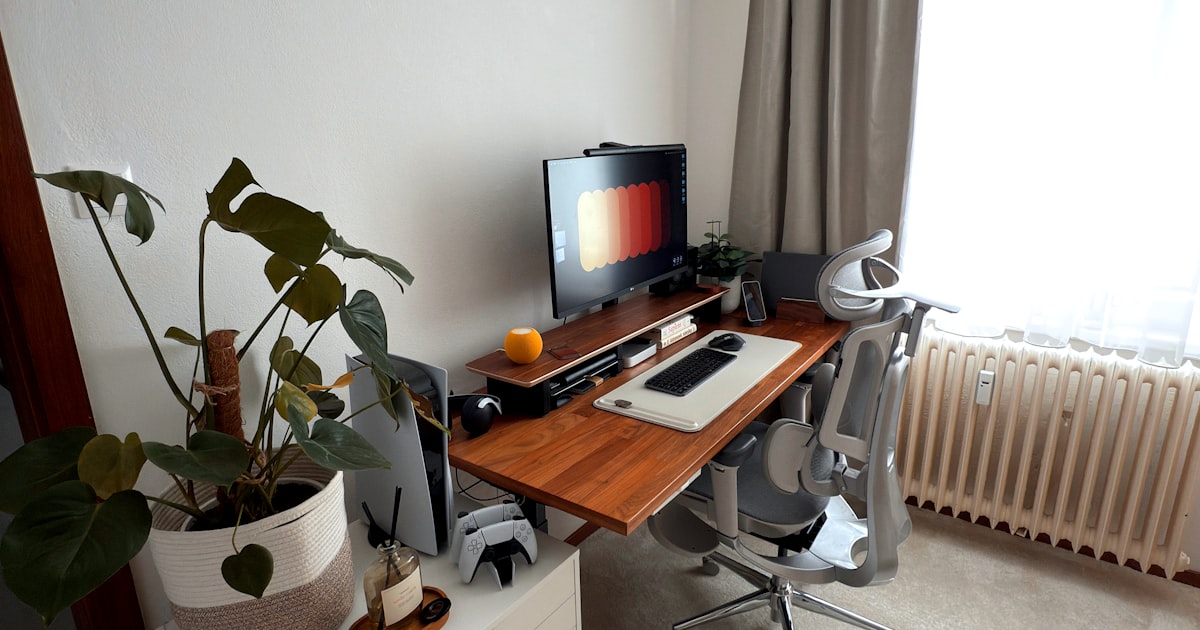
Put your desk so you can see the door without sitting directly in line with it, and keep a solid wall or solid furniture behind your chair. That is the command position, and it matters more than your chair, your monitor, or your lighting. Once that is set, your Kua number tells you which direction to face for the strongest additional benefit to focus and career momentum.
Why facing a wall wears you down
Most people push their desk against a wall and work facing it, which puts their back to the door. Even alone in the house, this reads as low-level exposure. You notice movement in your peripheral vision, or you find yourself checking your phone more, and the room never quite settles.
Facing a blank wall closes off your visual field too. There is nowhere for your eyes to rest at a distance, which adds eye strain on top of the exposure problem. Compare that with a coffee shop. Most people gravitate to the seat with a wall behind them and the room open in front, without ever thinking about why. That is the command position, chosen instinctively.
The ideal setup
A desk placed diagonally from the door is the easiest way to get this right. You can see the entrance without staring straight at it, and your chair faces into the room rather than a wall.
If space forces your desk against a wall, choose the wall that lets you see the door with a slight turn of the head rather than none at all. If you truly cannot avoid facing away from the door, a small mirror on the desk or monitor solves it without a room redesign.
Keep the space behind your chair clear. A shelving unit or storage cabinet directly behind you undercuts the same sense of protection a solid wall gives. Open space in front of the desk, where you have it, gives your eyes a place to rest and your mind room to wander productively between tasks.
Which direction you should face while you work
The command position is the same for everyone. Which compass direction you face once it is satisfied is personal, and it comes from your Kua number, the same figure that sets your best sleeping direction.
Your Kua number gives you four favorable directions. One of the four is your prosperity direction, tied to career momentum and forward progress, and it is the one most worth using at a desk if the room allows it. If the layout does not cooperate, your stability direction is the reasonable second choice, since it supports focus and clear thinking rather than pure ambition.
The calculation depends on your exact birth date, not just the year, because the Chinese solar year turns over on February 4 rather than January 1. Get your number from the Kua number calculator, which applies that cutoff correctly and returns all four of your directions at once.
As with the bedroom, apply the direction only after the command position is already satisfied. A desk facing your prosperity direction with your back to the door is a worse setup than a desk in the command position facing your fourth-best direction. Safety and focus come first, orientation is the layer on top.
What sits on and around the desk
Keep the surface itself as clear as you can manage day to day. Every object on it is something your eyes and brain register, even without your noticing, and a cluttered desk creates a steady low-level distraction.
A small plant near the desk, something like a pothos or a snake plant, is a reasonable addition and does no harm. Light matters more than most people think: natural light from a side window beats harsh overhead lighting, and a warm desk lamp in the 2700 to 3000 Kelvin range feels calmer through the afternoon than cool white light, which tends to keep you keyed up past the point it is useful.
When the office is also the bedroom
This is the reality for a lot of renters and small apartments. The core rule is to create a boundary between the work zone and the sleep zone, even a modest one. A bookshelf, a folding screen, or simply angling the desk so it faces away from the bed all work.
Close the laptop at the end of the day and, if you can manage it, turn the chair away from the desk overnight. These are small signals, but they tell your nervous system that work has ended, and a desk facing the bed with a screen visible from the pillow is the single most common reason people in this situation say they cannot switch off at night.
Five changes that take under an hour
Turn the desk so you can see the door, even with a mirror if the room will not allow the real thing. Add a plant within reach of the desk. Clear the surface down to what today's work actually needs. Swap overhead lighting for a warm desk lamp. If the office shares a room with the bed, put a physical divider between the two zones.
Give each change three to five days before adding the next one. Most people notice the difference in focus within a couple of days, and it compounds once all five are in place together.
None of these five require moving the desk to a new room or buying furniture. The command position is achievable at almost any desk with a mirror, a plant, and an hour of tidying, which is why it is worth doing before anything more expensive.
Frequently asked questions
Where should a desk face for feng shui?
Diagonally from the door, so you can see the entrance without sitting directly in its path, with a solid wall or solid furniture behind your chair. This command position matters more than which compass direction the desk points.
What direction should I face while working, according to feng shui?
Your Kua number, calculated from your exact birth date and gender, gives you four favorable directions. The strongest one for work is usually your prosperity direction, tied to career momentum. Use it only after your desk is already in the command position.
My desk has to face a wall. What do I do?
Add a small mirror on the desk or monitor angled so you can see the door behind you. It solves the exposure problem without a room redesign, and it works nearly as well as physically turning the desk.
Is it bad to have my desk facing my bed?
It blurs the line between rest and work, and it is the most common reason people in shared rooms say they cannot wind down at night. A folding screen, a bookshelf, or simply angling the desk away from the bed fixes it without needing a separate room.
How do I find my personal work direction?
You need your exact birth date, since the Chinese solar year turns on February 4 rather than January 1 and using the wrong year can flip your entire result. The [Kua number calculator](/tools/kua-number-calculator) applies that cutoff and gives you all four of your directions.