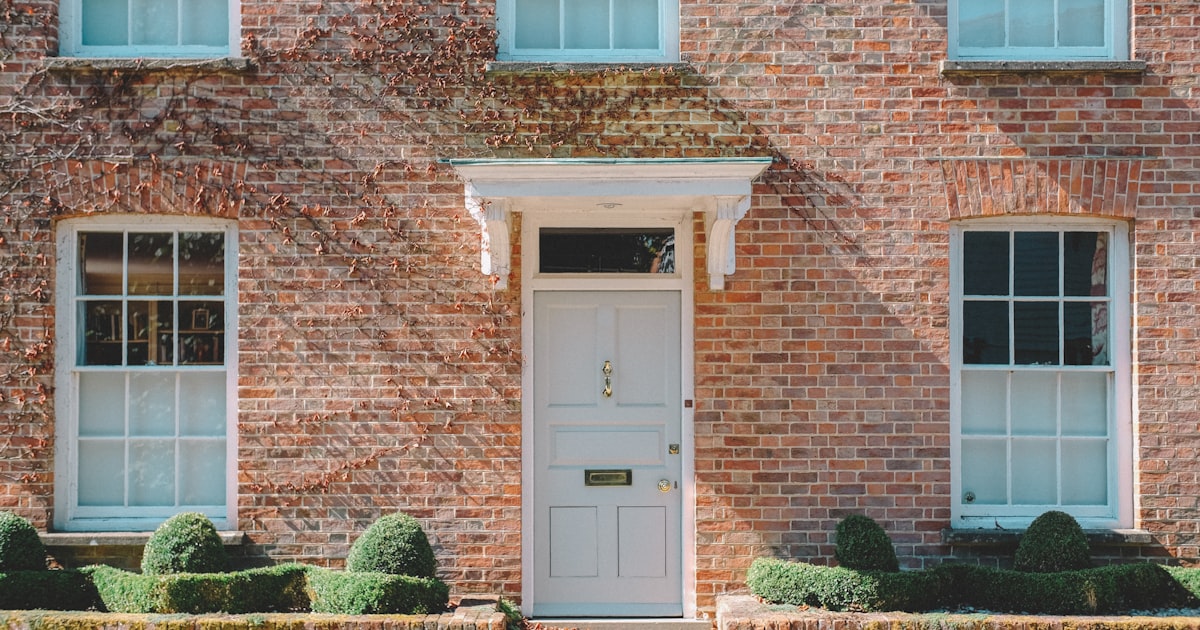
Your front door matters more than any room inside your house, and almost every rule about it depends on one number you probably do not know: the compass direction it faces. Find that number first. Every piece of advice about color, plants and placement changes depending on the answer.
Most feng shui writing skips straight to the advice. It tells you that a south-facing door wants red and an east-facing door wants green, and then it never tells you how to work out which one you have. That is the part that actually takes work, so that is where this starts.
How to find which direction your front door actually faces
There are three ways to get this number, and they are not equally good.
The compass method. Stand with your back flat against the closed front door, facing out the way a visitor would face in. Read the compass bearing straight ahead of you. That bearing is your facing direction. The problem is that a phone compass sits inside a metal door frame, near wiring, sometimes near a steel lintel, and it will happily be off by fifteen or twenty degrees without telling you. Step three to four metres away from the building before you read it, keep the same line, and take the reading three times.
The map method. Open a satellite map, find the roof of your house, and find the road it fronts. Draw the line that runs from the middle of the building out through the front door to that road. The bearing of that line is your facing direction. This is more reliable than a phone compass because it is geometry rather than magnetism, and it is how a surveyor would do it.
The road geometry method. This is the one we use, and it is the map method done by arithmetic instead of by eye. Take the coordinates of the property, take the shape of the road segment it fronts, and compute the bearing of the perpendicular from the building to that road. It returns a number to the degree, and it does not care whether you held your phone level.
Here is what that looks like on a real case. A single-storey house sits on the north side of an east-west residential street. The road runs at 88 degrees. The perpendicular from the building out to the road points at 178 degrees, which is very nearly due south but not quite. In the compass school that one-degree-either-side distinction does not change much, but the 178 figure does tell you something the word "south" does not: the door sits at the end of the south sector rather than the middle of it, which matters when you get to the year charts, because sector boundaries fall at 157.5 and 202.5 degrees and a door at 200 degrees is a different reading from a door at 178.
Two cases break all three methods, and it is worth knowing whether you are one of them.
Corner lots. If your property fronts two streets, the geometry will pick the longer frontage, and the longer frontage is often not where the front door is. If your door opens onto the short side of a corner lot, override the computed number with the direction the door itself points.
Flag lots and long driveways. If your house sits well back from the road down a private drive, the road is not what the house addresses. The facing is the direction the door looks out along the drive, not the bearing to the public street.
You can get the computed number for your own address from our free reading. It reads the road geometry, returns the bearing to the degree, and lets you correct it on a picture of your own roof if you are one of the two cases above.
The five things that matter, in order
Once you know the direction, the rest has an order to it. These are ranked by how much difference they make, not by how often they get written about.
One, the door has to work. It should open fully, swing without sticking, and close without being shoved. A door that resists is the oldest and least mystical rule in the subject: the entrance to your home should not fight you. If yours sticks, that is a hinge adjustment or a strike plate moved by two millimetres, and it takes twenty minutes.
Two, light. A dark entry is the single most common problem and the cheapest to fix. Energy follows light in the traditional framing, and in the plain framing a dark entry is where people put things down and forget them. If you cannot read a house number at the door at nine at night, it is too dark.
Three, the path in. Not the room, the path. There should be a clear route from the door into the rest of the house that a person carrying a box could walk without turning sideways. Shoes, bags and stacked mail narrow that route.
Four, what sits directly opposite. A mirror facing the door reflects what comes in straight back out. A wall a metre inside the door is a dead end. A staircase rising directly in line with the door pulls everything up and past the ground floor too fast. All three are fixable, and none require moving the door.
Five, the color. This is the one everyone leads with and it belongs fifth. It matters, but a beautifully painted door that sticks in a dark entry is not a good front door.
Door color by direction, all eight answers
This is the part that needed the direction. Find your bearing in the first column.
| Facing | Sector | Element | Colors that support it | Colors to avoid |
|---|---|---|---|---|
| 337.5 to 22.5 degrees | North | Water | Black, deep blue, charcoal | Strong yellow, terracotta |
| 22.5 to 67.5 degrees | Northeast | Earth | Beige, sand, soft yellow, stone | Deep green |
| 67.5 to 112.5 degrees | East | Wood | Green, brown, warm timber | White, bright silver |
| 112.5 to 157.5 degrees | Southeast | Wood | Green, teal, timber | White, bright silver |
| 157.5 to 202.5 degrees | South | Fire | Red, orange, deep pink | Black, deep blue |
| 202.5 to 247.5 degrees | Southwest | Earth | Ochre, warm brown, terracotta | Deep green |
| 247.5 to 292.5 degrees | West | Metal | White, grey, soft metallic | Red, orange |
| 292.5 to 337.5 degrees | Northwest | Metal | White, silver, pale grey | Red, orange |
The 178-degree house above lands in the south sector, so red, orange or a deep warm pink on that door, and not the fashionable charcoal that would have been the obvious choice from a paint chart.
One note on the year. 2026 is a Fire Horse year, running from February 4, 2026 to February 3, 2027, and a small red or gold accent at the entrance suits the year regardless of which direction the door faces. That is an accent, not a repaint. Do not paint a west-facing door red because of the year and then live with it for the next decade.
What to do when the door faces a problem
Some entrances have a problem you cannot paint over, because the problem is outside the property line. You cannot move a road. What you can do is treat it, and treating it properly is worth more than knowing about it.
A road pointing straight at your door. The traditional term is a rushing arrow, and the situation is a T-junction where your house sits at the top of the T with headlights arriving at the front of the building. In plain terms you have traffic, light and noise aimed at your entrance instead of running past it.
- Best: break the line of sight with something solid and living. A dense hedge or a pair of substantial shrubs set forward of the door, tall enough to interrupt headlight height, which means about 1.4 metres. Budget roughly $200 to $800 depending on how mature you buy them.
- Next best: a low masonry wall or a raised planter bed across the approach, offset so the path bends rather than running straight in. Roughly $800 to $3,000.
- Backup: a convex mirror or a reflective plaque above the door frame, facing out. This is the traditional cure and it costs under $50. It does nothing about the noise, so treat it as the option for renters and for people waiting on the hedge to grow.
A door that opens onto a wall. You have about a metre of hallway and then a dead end.
- Best: if the wall is not structural, open it up or cut a pass-through. This is real building work, roughly $1,500 to $6,000.
- Next best: put something on that wall that gives the eye somewhere to go. A large piece of art with depth in it, or a mirror angled to the side rather than square on, so it opens the space without bouncing the entrance back out the door. Roughly $100 to $500.
- Backup: a lamp on the wall and a runner leading away from the dead end toward wherever the house actually opens up. Under $150.
A staircase directly in line with the door.
- Best: a runner on the stairs in a color that reads as heavier than the floor, plus a solid piece of furniture set to one side of the entry so the eye stops before it climbs. Roughly $200 to $700.
- Next best: a round-leafed plant at the foot of the stairs and a light at the base rather than the top, so the ground floor is the brighter place. Under $150.
- Backup: a wind chime or a faceted crystal hung between the door and the bottom step. Under $30, and honest about what it is, which is a marker rather than a fix.
The costs above are rough US figures for planning, not quotes. They vary a lot by region and by contractor, so get a local price before you budget on any of them.
In every one of these, the general cure is the same for anybody with that problem. What changes is which cure suits your specific building, which direction the trouble arrives from, and which side of your house it lands on.
The next thing you probably want to know
You now have a direction and a color. The question that follows is what is on each side of that direction, because the front door is one point on a building and the year charts apply to the whole of it.
We can see your entrance and the road it faces from above. Enter your address and we will tell you what your front door is actually pointed at, to the degree, along with the street it fronts. The first findings are free.
Frequently asked questions
What is the best feng shui color for a front door?
It depends entirely on the direction the door faces. South-facing doors take red or orange, east and southeast take green or timber tones, north takes black or deep blue, west and northwest take white or grey, and northeast and southwest take sand and earth tones. Find the direction before you buy paint.
How do I find which direction my front door faces without a compass?
Use a satellite map. Find your roof, find the road you front, and read the bearing of the line running from the middle of the building out through the door to the road. That is your facing direction, and it is more reliable than a phone compass held next to a metal door frame.
Is it bad feng shui to have a mirror facing the front door?
Yes, and it is one of the easier problems to fix. A mirror square on to the door reflects what arrives straight back out. Angle it to the side or move it to a wall the door does not look at. You keep the light and lose the problem.
Does the front door direction matter more than the door color?
Yes, because the direction is what decides the color. It also decides how the year charts land on your building and which side of the house the year's difficult positions fall on. The color is a consequence of the direction, not a separate choice.
What if my house has two front doors?
Use the one people actually arrive at and the one the address points to. In feng shui terms the facing is about how the building addresses the world, not about how many openings it has. If deliveries and visitors come to the side door, that is the door that counts, even if the architect drew a grander one on the front.
Does any of this apply if I rent?
The direction does, and so does everything about light, clutter and what sits opposite the door. The paint usually does not, and you should not repaint a door you do not own. Every cure listed above has a backup option that leaves no mark.