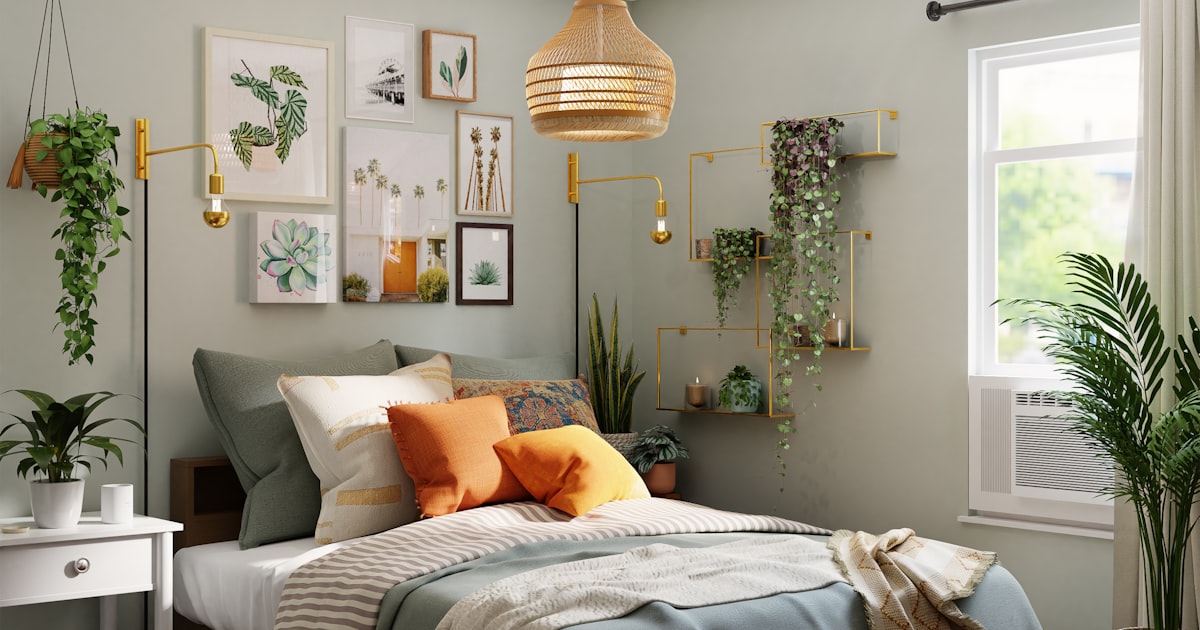
Apartment feng shui runs into the same constraints renting always does: you cannot move walls or choose the building's orientation. What you control is furniture placement, mirrors, sound buffers and light, and every common apartment problem in this article has a workaround that needs no landlord's permission.
The Renter's Priority List
When you cannot change everything, change the things that matter most. Here is the order: first, get the bed in the best possible position (command position or as close to it as you can get). Second, close all doors at night (closet, bathroom, bedroom). Third, cover or angle any mirror that reflects the bed. Fourth, clear clutter from under the bed and nightstands. Fifth, add one plant.
Those five steps cost almost nothing and take under an hour. They address 80% of bedroom feng shui without any renovation.
Studio Apartment Layout
The biggest challenge in a studio is that your bed, desk, couch, and kitchen all share one room. In feng shui, the bedroom should be separate from active spaces. Since you cannot build a wall, create visual zones instead.
A bookshelf, a folding screen, or even a curtain on a ceiling track can separate the sleeping area from the living area. Position the bed so it is in the command position (headboard against a solid wall, able to see the door). Use the farthest corner from the entrance as your sleep zone if possible.
In a studio, the single most impactful change is creating a visual barrier between your bed and the rest of the room. Even a tall plant or a bookshelf turned sideways creates enough separation for your brain to register "this is the sleep zone."
Noise, Neighbors and Shared Walls
The complaint that never appears in feng shui books is the one most apartment dwellers actually have: you can hear other people. A shared wall behind the headboard is the version that matters, because it puts unpredictable sound directly behind where you sleep, which is the one place the whole tradition asks you to keep solid and quiet.
If the bed can move to an internal wall, move it. If it cannot, a padded headboard, a heavy bookcase or even a hanging textile on that wall does real acoustic work as well as giving you the sense of backing that the position is asking for. This is one of the rare cases where the traditional advice and the practical fix are the same object.
Entrances, Corridors and the Door You Share
Apartment front doors open onto a corridor rather than onto the outside, so the entrance you control is small. Make the few feet inside it do the work. Keep that space clear enough to put a bag down, give it light that comes on without hunting for a switch, and do not let it become the place shoes and post accumulate.
A door that opens onto a blank wall a step away is common in apartments and feels abrupt. A mirror on the side wall rather than facing the door, or a picture with some depth to it, gives the eye somewhere to go without bouncing you straight back out.
What Is Worth Asking a Landlord For
Most of this article needs no permission. Two things are worth asking about anyway, because they are cheap and landlords often say yes: replacing a single harsh overhead fixture with something warmer, and permission to put two or three hooks or fixings in a wall. Warmer, lower light changes how an apartment feels at night more than any object you could add, and a headboard fixed to the wall solves the shared wall problem properly.
If the answer is no, both have freestanding versions. Lamps do the light job, and a tall upholstered headboard that sits behind the bed under its own weight does most of the wall job.
See this for your own address
The building your apartment sits in has a real facing direction even though your unit inside it does not. See what that means by entering the building's address, free.
Frequently asked questions
Can you do feng shui in an apartment?
Yes. Feng shui principles apply to any space regardless of size or ownership. Apartments have more constraints (shared walls, fixed layouts, rental restrictions), but every constraint has a practical workaround. Furniture placement, mirrors, plants, and lighting are all within a renter's control.
How do I feng shui a studio apartment?
Create visual zones that separate sleep from living/work areas using a bookshelf, folding screen, or curtain. Place the bed in the command position (headboard against a solid wall, able to see the entrance). Keep the sleeping zone in the farthest corner from the front door. Close closet doors at night.
What if my bed can only go in one position?
When the bed cannot move, adjust everything else. Close all doors at night, cover or angle mirrors, add a solid headboard, place a rug under the bed, and use warm lighting. These compensating adjustments address most feng shui concerns even with a fixed bed position.
How do I handle mirror closet doors in a rental?
Use a tension rod and fabric panel to create a curtain over the mirrors. Frosted window film is another removable option. Or rearrange bedroom furniture so the mirrors do not reflect the bed. All of these are renter-friendly and reversible.
--- ---