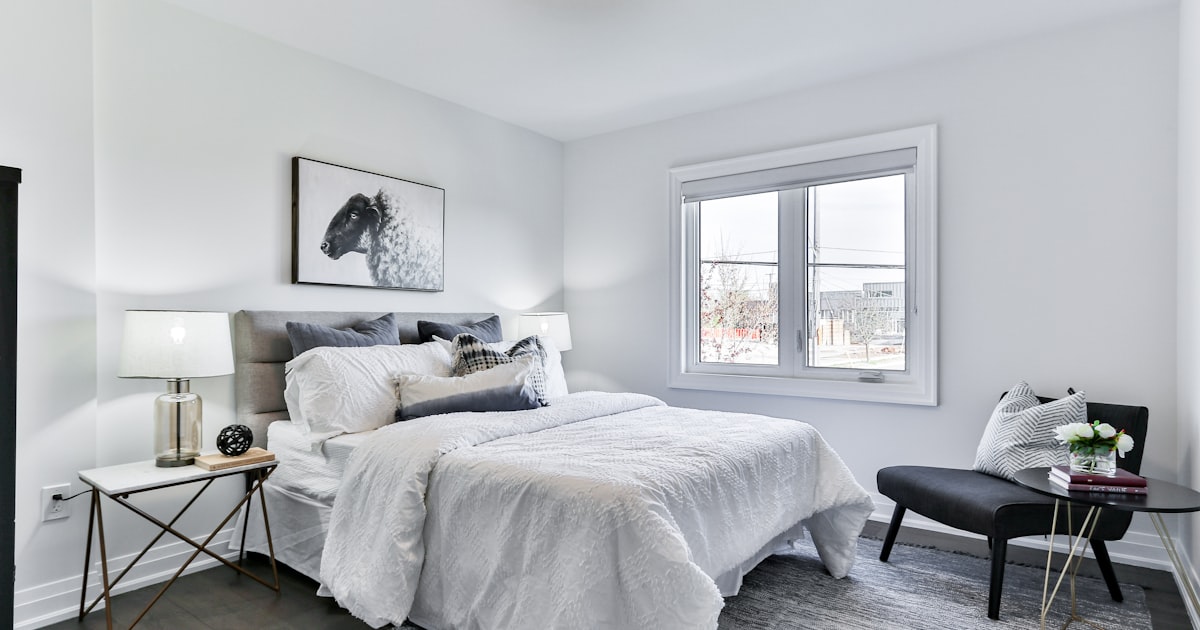
The best direction for your bed depends on your personal Kua number, calculated from your exact birth date and gender, not a rule that applies to everyone equally. East Group people sleep best with their head pointing east, southeast, south or north. West Group people do better facing west, northwest, southwest or northeast. Direction is one layer on top of a more important one: whether your bed is in the command position at all.
If you have searched "should I sleep facing north or south" you have probably found a dozen conflicting answers. They disagree because most of them skip the part that actually matters, which is your Kua number. Without it, direction advice is a guess dressed up as a rule.
What a Kua number actually is
A Kua number is a single digit, one through nine, skipping five, calculated from your birth year and gender. It comes from the Eight Mansions system, one of the older and more widely used frameworks in the subject. It sorts everyone into an East Group or a West Group and gives each group four favorable directions and four unfavorable ones.
Two people born in different years can have completely opposite ideal directions. That is why "sleep facing south" as a blanket rule falls apart the moment you check it against a real birth date.
The calculation, and the date that trips people up
Add the last two digits of your birth year together until you reach a single digit. For men born before 2000, subtract that digit from 10. For men born in 2000 or later, subtract from 9. For women born before 2000, add 5. For women born in 2000 or later, add 6. If the result is two digits, add them again. If you land on 5, it becomes 2 for men and 8 for women.
A woman born in 1990: 9 plus 0 is 9, plus 5 is 14, and 1 plus 4 is 5, which becomes 8 for a woman. Her Kua number is 8, West Group.
Here is the detail that most articles skip. The Chinese solar year turns over on February 4, not January 1. If you were born between January 1 and February 3, your calculation uses the previous year, not the calendar year on your birth certificate. Someone born January 20, 1990 calculates as 1989, and that is not a rounding error. A man born January 20, 1990 comes out Kua 2, West Group. A man born June 1, 1990, same year on paper, comes out Kua 1, East Group. Same birth year, same gender, opposite groups, all four directions flipped.
Rather than doing this arithmetic by hand and risking that exact mistake, enter your full birth date into the Kua number calculator. It applies the February 4 cutoff automatically and returns your number, your group, and your four directions in one step.
Your four directions
Each of your four favorable directions supports something different. One is your prosperity direction, the strongest for career and forward momentum. One is your health direction, best for physical recovery. One is your relationships direction. One is your stability direction, good for calm and clarity.
Kua 1: prosperity southeast, health east, relationships south, stability north. Kua 2: prosperity northeast, health west, relationships northwest, stability southwest. Kua 3: prosperity south, health north, relationships southeast, stability east. Kua 4: prosperity north, health south, relationships east, stability southeast. Kua 6: prosperity west, health northeast, relationships southwest, stability northwest. Kua 7: prosperity northwest, health southwest, relationships northeast, stability west. Kua 8: prosperity southwest, health northwest, relationships west, stability northeast. Kua 9: prosperity east, health southeast, relationships north, stability south.
Why two people in the same bed get different answers
Two people sharing a bed almost never share a Kua number, because the number depends on birth year and gender both. A couple can easily land in opposite groups entirely, meaning every one of one partner's favorable directions is the other partner's unfavorable one.
This is not a flaw in the system. It is just what happens when you calculate two independent numbers and compare them. The fix is not to average them or split the difference on compass heading, which does not really mean anything directionally. Instead, look for whichever of the two people's favorable directions overlap, if any do. If there is a genuine overlap, that is the direction to use. If there is none, prioritize whichever partner has more trouble sleeping or a real health reason to need their direction more, and let the other person use their own favorable direction somewhere else in the home, at a desk or a reading chair.
This only becomes a live decision once you know both numbers, which is why calculating them separately matters more than guessing at a shared answer.
Command position outranks direction, always
The direction that matters is where the crown of your head points lying down. But the command position, meaning a solid wall behind the headboard and a clear view of the door without lining up with it, matters more than compass direction. If pointing your head toward your best direction means your back faces a window or your feet point straight at the door, do not do it.
The priority order is command position first, seeing the door second, favorable direction third. Never trade the first two away for the third. A room does not care about your Kua number if the wall behind your head is a window.
When your best direction is not available
Most bedrooms do not offer unlimited options. If your top direction means the bed goes under a window or two feet from a wall, that is not a good trade. Use your second or third best direction instead. The gap between your best direction and your second best is small next to the gap between a good layout and a bad one.
Does sleeping direction actually affect sleep
The evidence for the compass claim itself is thin. No peer reviewed study shows that facing southeast in particular makes you wealthier. What is much easier to defend is the part underneath it: people sleep better in a room where they feel settled and unexposed, and a bed you can see the door from, with something solid behind your head, is what feeling unexposed looks like in a bedroom. That is the thing feng shui has always been describing, whatever vocabulary it used to describe it.
Whether the Kua system works through the compass or through the discipline of being intentional about your room, the practical result reported by people who try it tends to be the same: better sleep once the arrangement gets attention.
Frequently asked questions
What is the best direction to sleep in feng shui?
It depends on your Kua number, calculated from your birth date and gender. East Group people, Kua 1, 3, 4 and 9, sleep best facing east, southeast, south or north. West Group people, Kua 2, 6, 7 and 8, do better facing west, northwest, southwest or northeast. There is no single direction that works for everyone.
Should I sleep facing north or south?
It depends entirely on your Kua number. For some numbers both directions are favorable, for others both are unfavorable. Calculate your number first, then check which of the two applies to you specifically.
What is a Kua number?
A personal number from 1 to 9, skipping 5, calculated from your birth date and gender under the Eight Mansions system. It sets your four favorable and four unfavorable directions for sleeping, working, and other activities.
My partner and I have different Kua numbers. What do we do?
Check both sets of four directions for any overlap. If one exists, use it. If none exists, prioritize whichever of you sleeps worse or has a health reason to need the direction more, and let the other person use their own direction at a desk instead.
Does the command position matter more than sleeping direction?
Yes. A solid wall behind the headboard and a clear view of the door affect sleep quality directly. Compass direction is a secondary optimization applied only after the command position is already satisfied.
Is there real evidence for any of this?
Not for the compass claim specifically. There is real evidence that spatial arrangement and feeling settled in a room affect sleep quality, which is the mechanism the Kua system may actually be working through.