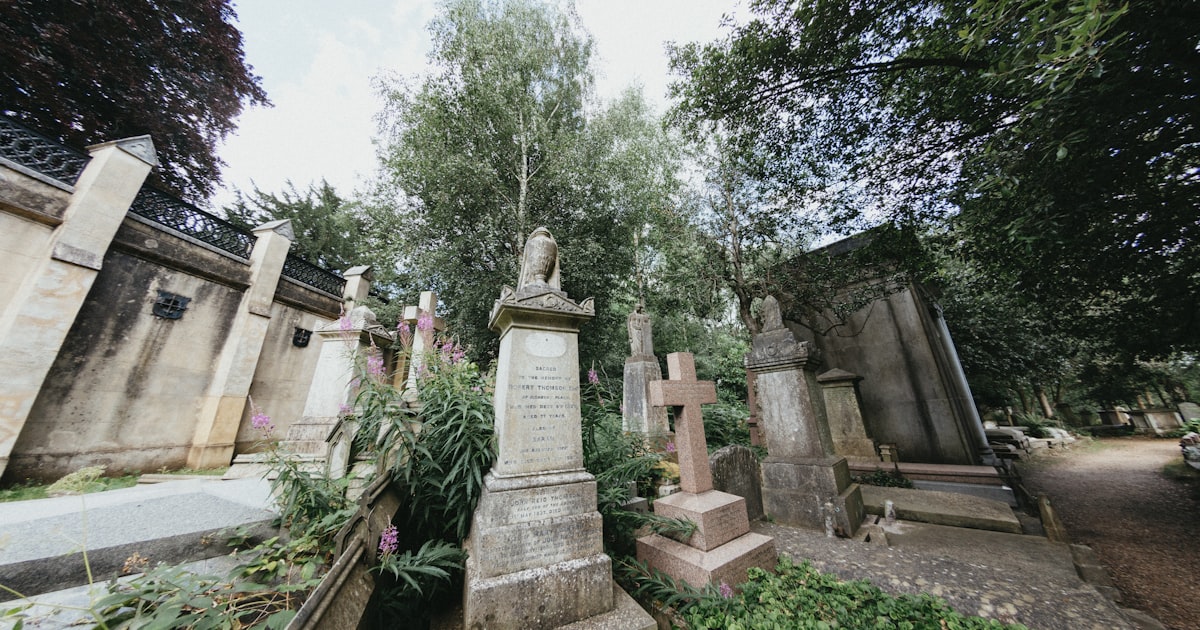
A house near a cemetery is not automatically bad feng shui. Traditional practice treats a cemetery as a source of stillness rather than danger, and its effect depends on three measurable things: distance, sightline, and which side of the house it sits on. Most homes near one need small adjustments, not alarm.
You probably noticed it on the drive to the viewing. The street was quieter than the ones around it. The listing photos cropped carefully, the agent mentioned "the green space across the road" a little too smoothly, and when you stood on the porch you could see the gates, or just the long iron fence. Nothing about it felt threatening. It felt still. And then that evening someone asked, is it not bad luck to live next to a cemetery, and the question stuck.
Here is the honest version of the answer: what the tradition says, what drives the feeling, how to judge your own situation with real measurements, and what to do about it.
Why a Cemetery Feels Different, in Plain English
The real issue with living near a cemetery is an absence of activity, not the presence of anything harmful. A cemetery generates no traffic, no lights in the evening, no voices, no commerce, and no change from season to season. It is the quietest neighbor you will ever have, and human beings are tuned to notice when one direction of their surroundings is permanently silent.
Think of a shop on a street where every other storefront is closed. There is nothing wrong with the shop itself. The street simply gives it no life, and customers feel that before they can explain it. A home bordered by a large, permanently still space can feel the same way: fine inside, but with one flank that contributes no energy at all.
Feng shui has a name for this. Living activity, movement, light, and warmth are called yang. Stillness, darkness, cold, and rest are called yin. A cemetery is one of the strongest yin environments in the tradition, so a house beside one sits in a yin-heavy setting. The classical concern is imbalance: a home is meant to be a place of active life, and too much surrounding stillness may, over time, leave a household feeling heavy or slow to change. Note the words may and over time. Even in traditional texts, this is a condition to manage, not a curse.
There is also a practical layer with nothing to do with belief. Streets beside cemeteries tend to have less evening foot traffic and less ambient light. Some people find that restful. Others find it isolating, especially at night. Which person you are matters more than any rule.
What Actually Determines How Much It Matters
The severity of a cemetery nearby comes down to distance, sightline, and position, and those three factors can move the reading from minor concern to moderate importance. No cemetery situation in an ordinary neighborhood reaches high importance on its own.
Distance
Within about 300 feet, the condition carries moderate importance. Between roughly 300 feet and a quarter mile, it drops to a minor concern, especially if buildings or mature trees stand between. Beyond a quarter mile, with no direct view, it is mostly traditional: a fact about the neighborhood rather than a factor in the home.
Sightline
A direct, unbroken view of graves from your front door or main living windows matters more than raw distance. A cemetery 200 feet away but fully screened by a hedge or a row of houses often reads softer than one 500 feet away in plain view from the kitchen sink. If you cannot see it from anywhere you regularly stand or sit, its influence in practice is small.
Position relative to the house
Feng shui reads the front of a home as its active face, the side that should meet movement and light, and the back as its resting support. A cemetery directly facing the front door places the stillness exactly where the tradition wants liveliness, which is the least favorable arrangement. A cemetery behind the property is usually read more gently, closer to a quiet green backdrop. To one side is the mildest case. Enter the address in our free reading and it works the facing direction out from the road the property fronts, along with what sits around it.
Character of the cemetery itself
A maintained, park-like cemetery with lawns and old trees reads very differently from a neglected one. An active funeral home or crematorium adjacent to the property is a separate, stronger consideration. And stories about spirits are mostly traditional, and not something this article will use to frighten you.
A Worked Example
Judging a real house takes about ten minutes with a map. Suppose you are looking at a 1960s ranch on the north side of Alder Street, which runs east to west. The front door faces the street at 187 degrees, almost due south. Directly across Alder Street is the boundary fence of a twelve acre cemetery. Measuring on the satellite view, the fence line is 145 feet from the front door, and the nearest row of headstones is about 260 feet away, partly screened by a line of mature maples inside the fence.
Read it factor by factor. Distance: 145 feet to the boundary is close, inside the 300 foot band, so this leans moderate. Sightline: from the porch you can see the fence and treetops, but the maples block most of the graves; from inside the living room the view is fence and green. That softens it. Position: the cemetery sits dead ahead of the facing direction, the least favorable side, which firms it back up. Character: mowed lawns, old trees, gates locked at dusk. Verdict for this specific house: a genuine moderate concern, driven mostly by the front-facing position, and clearly workable with the cures below. If the same cemetery sat behind the lot, or 600 feet down the street, this would drop to a minor concern.
Notice what did the work: feet, degrees, and a sightline you can check from the curb. Any house can be read the same way, and the reading differs at every address.
The Buyer's Verdict
For a home buyer, a nearby cemetery is best classified as important but context-dependent, and it is permanent, because the cemetery will not move. Here is the direct answer: a cemetery nearby should not, by itself, stop a purchase. It should slow one down enough to check three things.
First, walk the street at 8 or 9 in the evening, not just at the daytime showing. The quiet is the real feature you are buying. Decide honestly whether it lands on you as peaceful or as lonely.
Second, measure rather than estimate. Pull up the satellite view, measure the distance from the house to the boundary and to the nearest graves, and stand at the front door to check the sightline. A vague sense of "it is close" produces anxiety; a number produces a decision.
Third, price in the resale question. Some buyers will rule the house out no matter what you do, which can thin the future buyer pool. The same effect often shows up as a friendlier purchase price today. That is a trade, not a defect.
If you are weighing several properties at once, our guide to checking a home before you move in walks through the full exterior checklist; the cemetery is one line item, not the whole verdict.
The Cures, Ranked
Every cure for a yin-heavy setting works the same way: add life, light, and movement on the side of the home that faces the stillness. You are not sealing something out. You are balancing the ledger. Ranked from strongest to simplest:
Best: light the facing side, on a schedule. Warm exterior light is the most direct yang addition there is, and it works on the exact boundary where the stillness meets your home. Put a warm-white bulb on the porch or the cemetery-facing wall and run it on a dusk timer, and add two or three solar path lights along the walk. Cost: under $50 all in. It ranks first because it changes the evening character of the whole approach, which is when a cemetery-side street feels most empty.
Next best: put living things in the sightline. A pair of healthy potted evergreens flanking the door, window boxes with real plants, or a bird feeder in the front yard all place visible, moving life between you and the view. Cost: under $30 to start. This ranks second because it works all day rather than only after dusk, but it needs upkeep; a dead plant on the cemetery side is worse than no plant.
Backup: soften the view and keep the front active, for free. Hang sheer curtains you already own on the windows with the most direct view, so daylight enters but the sightline blurs. Then use the front of the house: open the curtains every morning, come and go by the front door, keep the porch swept and the path clear. Cost: free. Stillness settles on a front that is never used; ordinary daily activity is itself a cure, so do this one alongside the other two.
Renter-friendly version: tension-rod sheers, a plug-in warm lamp near the facing window on a timer, and potted plants by the entrance. Nothing here needs a hole in a wall or a landlord's permission.
One thing you will find in older folklore is the advice to point mirrors at the cemetery to reflect energy away. Skip it. It does nothing observable, it can read as hostile to neighbors who visit graves, and it makes feng shui look like superstition. For the background on why balance-based cures are the credible core of the practice, start with what feng shui actually is.
What Not to Worry About
Most of the fears attached to cemeteries have no standing even in traditional feng shui, and you can put them down. You do not need to worry about spirits entering the house; that is ghost story material, not property analysis. You do not need to worry about a cemetery you cannot see and do not pass daily, even if it technically sits within a mile. You do not need to worry about a historic churchyard beside a church, which most readers treat as part of the church grounds. You do not need to worry that the condition worsens over time; a cemetery is one of the most stable land uses there is. And you do not need to rethink the inside of your home because of what sits outside it; if your bedroom feels fine, it is fine, though our front door guide covers what to do when an entrance faces something it should not.
One quiet neighbor does not define a property. A house near a cemetery with a bright approach, a solid layout, and a good orientation is a better home than a house next to a park with a dark entry and a door facing a wall.
No Rule Stands Alone
A cemetery reading should never be judged in isolation, because its weight depends on everything else the property has. The same cemetery lands differently on a south-facing house than a north-facing one, differently on a home with rising ground behind it than one exposed on a slope, and differently on a household of night-shift workers than a family with young children. Direction, road geometry, terrain, the other landmarks around the address, and the people who will live there all move the answer. That is exactly why generic articles, this one included, can only take you to the edge of a verdict.
If you are standing at that edge, with this address or one you are about to make an offer on, enter the address and we will show you what the home's facing direction, the road geometry, and what actually surrounds it mean for the people who would live there, including whether this concern is permanent, temporary, or fixable. The first findings are free.
Frequently asked questions
Is it bad luck to live near a cemetery?
No. Feng shui does not treat a cemetery as bad luck. It treats it as a strong source of stillness, called yin, which may leave a home feeling low in energy if nothing balances it. Distance, sightline, and which side of the house it sits on decide how much it matters, and simple cures address it.
How close is too close to a cemetery in feng shui?
Within about 300 feet with a direct view is the range where the condition carries moderate importance. From 300 feet to a quarter mile it is a minor concern, especially when screened by buildings or trees. Beyond a quarter mile with no sightline, it has no practical effect on the home.
Should I buy a house that backs onto a cemetery?
A cemetery behind the property is generally the softer arrangement, closer to a permanent quiet green space than a confrontation. It should not stop a purchase by itself. Visit in the evening, measure the actual distance on a satellite view, and factor the thinner future buyer pool into your offer price.
Is a house facing a cemetery worse than one beside it?
In traditional terms, yes. The front of a home is its active face, so stillness directly ahead of the front door is the least favorable position, while a cemetery to one side is the mildest. Facing arrangements are the ones most worth treating with lighting and greenery on the facing side.
Does living near a cemetery lower property value?
Often somewhat, because some buyers exclude these homes entirely, which can mean a lower purchase price for you now and a smaller buyer pool at resale. The effect varies widely by market and by how visible the cemetery is. Treat it as a pricing question to raise with your agent, not a hidden defect.
Do feng shui cures actually fix a cemetery next door?
They do not move the cemetery, and no honest practitioner will claim otherwise. What they do is rebalance the home's own environment with light, plants, and activity on the quiet side, which addresses the actual problem, a flank of the property that contributes no life. For most homes that is enough.