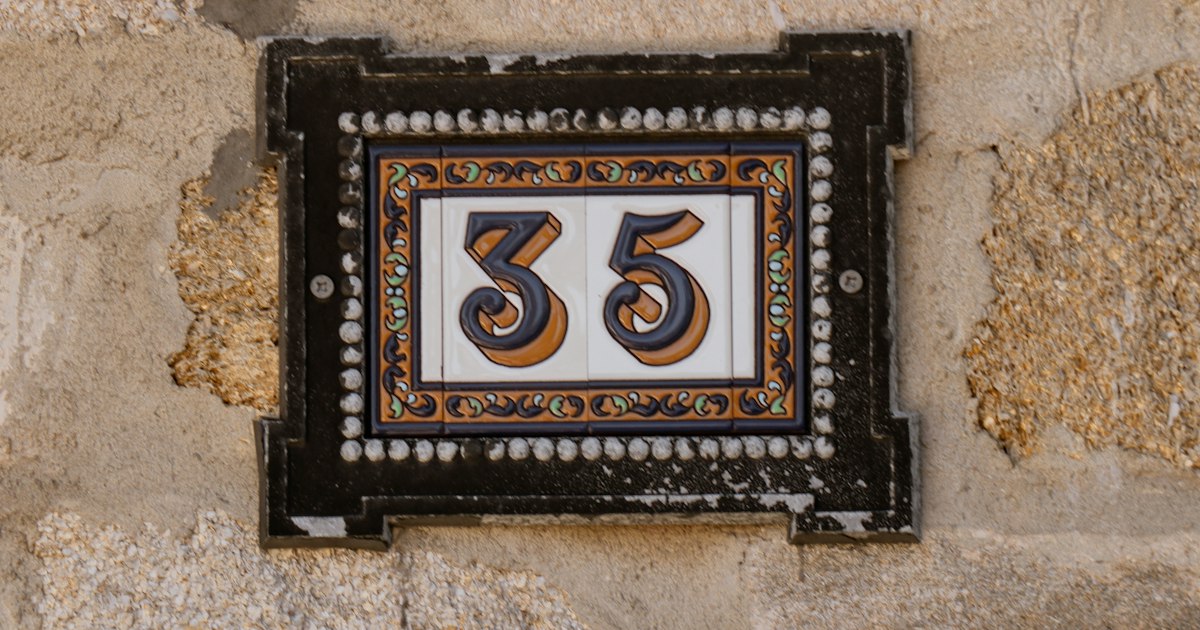
A house number by itself does not determine a home's feng shui. The number 4 and the number 13 are not cursed, and the number 8 does not guarantee wealth. What does matter, and what buyers should actually weigh, is how the number is perceived by future buyers in a resale market, plus the real feng shui factors the number gets mistakenly blamed for, such as the direction the front door faces and what sits across the street.
Picture two nearly identical houses on the same block. One is numbered 1444. The other is numbered 1448. A friend half jokes that the second house has better feng shui because 8 sounds like prosperity. You laugh it off, but the comment sticks with you anyway, especially if you are already unsure about the home for other reasons. That reaction, a small number on a mailbox changing how a house feels, is the entire phenomenon in one sentence. The number does not change the house. It changes how people read the house.
Where the number superstition actually comes from
The plain explanation comes first. In Cantonese and Mandarin, the word for "four" sounds close to the word for "death." The word for "eight" sounds close to the word for "prosperity" or "growing wealth." That is a language coincidence, a homophone, not a physical or environmental principle. It has nothing to do with compass directions, sunlight, road angles, or airflow, which is what classical feng shui was actually built to evaluate. Once you know the number superstition is a pun rather than a diagnosis of the property, it becomes much easier to keep in proportion.
This kind of number superstition is mostly traditional and cultural rather than a core feng shui practice. It shows up strongest in markets with large Chinese-buyer populations, where researchers studying home sales have found a small but measurable price pattern tied to the numeral 4 and the numeral 8, similar to how some Western buyers quietly avoid the number 13 on a house or hotel floor. That price effect is real and worth knowing if you plan to resell into that kind of market. It is a market perception effect, not evidence that the house itself is flawed.
The three layers people mix together
Most confusion about house numbers comes from blending three separate ideas into one. Separating them makes the topic much less mysterious.
The first layer is homophone superstition, the 4-and-8 pattern described above. This is folklore, moderate importance only in specific resale markets, and irrelevant to how the house actually functions day to day.
The second layer is digit-sum numerology, where people add the digits of an address together to reduce it to a single number, then compare that number to a list of supposedly lucky or unlucky outcomes. This method shows up often online, but it is not part of the classical form-school feng shui that evaluates roads, water, mountains, and building shapes. Label this one mostly folklore and minor concern. It makes for fun trivia, not a basis for a real estate decision.
The third layer is the one that is genuinely part of feng shui: the entrance itself, meaning the direction the front door faces, what the door can see, and how energy and people actually move from the street to the door. Classical practitioners sometimes reference numbers in a completely different way, through Flying Star charts that combine a home's construction period with its facing direction. That system uses number grids, but it requires an actual compass reading and a construction date, not just the digits printed on the mailbox. Conflating a Flying Star number grid with "my address adds up to 4" is where most of the internet gets this topic wrong.
What genuinely matters at the entrance
If a house number superstition is making you anxious, the more useful question is usually not "what does my number mean" but "what does my entrance actually do." A front door that opens onto a straight road pointed directly at it, a door with no clear sightline for whoever is arriving, or an entry path blocked by a wall or heavy planting, these are the things classical feng shui actually evaluates, sometimes described with the term sha qi, meaning fast, unobstructed movement aimed straight at an opening. Explained in plain terms first: it is the same reason a chair with a solid back against the wall feels more restful than a chair in the middle of an open room facing every doorway at once. The commanding position principle is about visibility and stability, not digits.
This is a useful modern analogy for the whole topic. Choosing a restaurant seat with your back to the door and a clear channel of foot traffic aimed at you is unsettling, no matter what the table number is. The table number is decoration. The seat itself is the substance. A house number works the same way. It rides along on top of the real conditions, road geometry, facing direction, what surrounds the lot, without being one of those conditions itself.
A worked example
Take a hypothetical property at 1444 Birchwood Lane, a street that runs roughly north to south, with the house sitting on the west side of the road so the front door faces east. Add the digits of 1444: 1 plus 4 plus 4 plus 4 equals 13, and 1 plus 3 reduces to 4. Under the digit-sum method, a superstitious reading would flag this address as unlucky before anyone has looked at the actual property.
Now look at what is real. The house sits back 42 feet from the road on a lot that is a comfortable rectangle with no odd angles. The front door faces due east, catching direct morning light, which many households find genuinely pleasant to live with, separate from any tradition. There is no road pointed straight at the door, no busy intersection nearby, and a low retaining wall about 30 feet from the house gives the entrance a sense of enclosure rather than exposure. On paper, using only the digit-sum method, this address looks unlucky. Walking the property, the actual conditions, the setback, the shape, the light, and the unobstructed but not overexposed entry, are ordinary to favorable. The number told you nothing useful. The property did.
How important is this, honestly
Home superstition (the 4 and 8 homophone pattern): minor concern for how the home lives day to day, moderate importance only if you expect to resell in a market where buyers are numerology-sensitive.
Digit-sum numerology: mostly folklore, minor concern, worth knowing about but not worth losing sleep over.
Flying Star number grids: a legitimate classical practice, but it requires a trained reading of the home's construction period and exact facing direction. It is not something a street number alone can tell you, so treat any online claim that reduces this to simple arithmetic with real skepticism.
Entrance exposure and road geometry: high importance. This is the part of "house number anxiety" that is usually actually about something else entirely, the door, the road, and the approach.
Should a house number affect your decision to buy
Use this to sort what you are actually looking at.
| Classification | What it means for this topic |
|---|---|
| Minor, market-dependent | The 4/8 homophone effect. Only relevant if you expect to sell into a numerology-aware buyer pool later. |
| Mostly folklore | Digit-sum numerology methods found online. Interesting, not diagnostic. |
| Context-dependent | Flying Star number analysis. Real, but requires a proper reading, not a guess from the address alone. |
| Important and property-specific | Entrance exposure, road angle, and facing direction, which a superstitious number reaction often points at without naming it. |
For a cautious buyer, a house number alone should never be the reason to walk away from an otherwise strong property, and it should never be the reason to choose a worse-fitting house over a better one. If the number bothers you enough that it would affect your own comfort living there, that is a legitimate personal consideration, since feng shui ultimately has to work for the actual person in the home. It is a preference, though, not a property defect.
What you can actually do about it
If a house number is bothering you, or a buyer you are selling to seems concerned about it, here are ranked options.
Best: change how the number reads without changing the digits, if local rules allow it. Spelling the number out on a secondary sign, using an alternate house name, or presenting the address differently in marketing materials during a sale addresses the perception issue directly. Cost is typically under $50 for a nameplate or secondary marker.
Next best: focus attention and staging on the entrance itself rather than the numeral. A well-lit, clearly visible front door with a clean sightline reads as welcoming regardless of the digits on it, and this addresses the feng shui factors that actually matter. Cost is often free to under $30 for lighting and simple entry cleanup.
Backup: if the municipal number cannot be changed and the property is not being sold into a numerology-sensitive market, simply do nothing. This is a legitimate option, not a compromise. The number superstition has no bearing on how the house functions.
Renter-friendly option: a small, tasteful nameplate or address plaque placed beside the official number, spelling the house name or a secondary identifier, requires no permission from a landlord in most cases and no permanent change to the property.
What not to worry about
Do not assume a 4 in your address means anything is wrong with the house. Do not assume an 8 guarantees anything good either. Do not spend money trying to "fix" a house number through decorative objects or rituals promising wealth or protection, since that crosses from a reasonable, low-cost adjustment into fear-based spending with no real basis. And do not let a number superstition distract you from the entrance conditions that are actually worth evaluating, the road, the setback, the facing direction, and what the door can see.
The bigger picture for your specific property
A house number should never be judged on its own. Its weight, if it has any at all, depends on the rest of the property: the direction the home faces, what the road in front of it actually does, what sits nearby, and who is going to live there. A number that would bother one buyer might mean nothing at all to another.
If a house number, or something else about a property, has left you uneasy and you want to know what is actually happening at that address rather than guessing from digits, enter the address and FengShuiReport will show you what the home's facing direction, the road geometry, and what surrounds it actually mean. The first findings are free.
Frequently asked questions
Is the number 4 always bad luck in feng shui?
No. The association between the numeral 4 and misfortune comes from a homophone in Cantonese and Mandarin, not from a feng shui principle about the property itself. It can affect resale perception in some markets, but it does not describe an actual condition of the home.
Does the number 8 guarantee a lucky or wealthy home?
No. The number 8 carries a positive association in Chinese numerology because it sounds similar to a word for prosperity, but a house number cannot substitute for the direction, road geometry, and layout factors that classical feng shui actually evaluates.
Can I change my house number if it worries me?
Often yes, through your local municipality, though the process and rules vary by city. A simpler option that avoids paperwork is adding a secondary nameplate or address marker near the entrance rather than changing the official number.
Should I avoid buying a house because of its street number?
Generally no. Treat the number as a minor, largely cultural factor. Spend your attention instead on the entrance, the road in front of the home, and the facing direction, which have a real and observable effect on how the property lives.
Does house number superstition actually affect resale value?
In some markets with a strong numerology-aware buyer base, yes, in a small and measurable way tied specifically to the numerals 4 and 8. In most markets, the effect is negligible compared to condition, location, and layout.
What is the difference between digit-sum numerology and real feng shui?
Digit-sum numerology reduces an address to a single number and compares it to a generic list of meanings, which is not part of classical form-school feng shui. Real feng shui evaluation of a home's entrance looks at the actual facing direction, the road, and what surrounds the property, tied to established compass and Flying Star methods rather than simple addition.