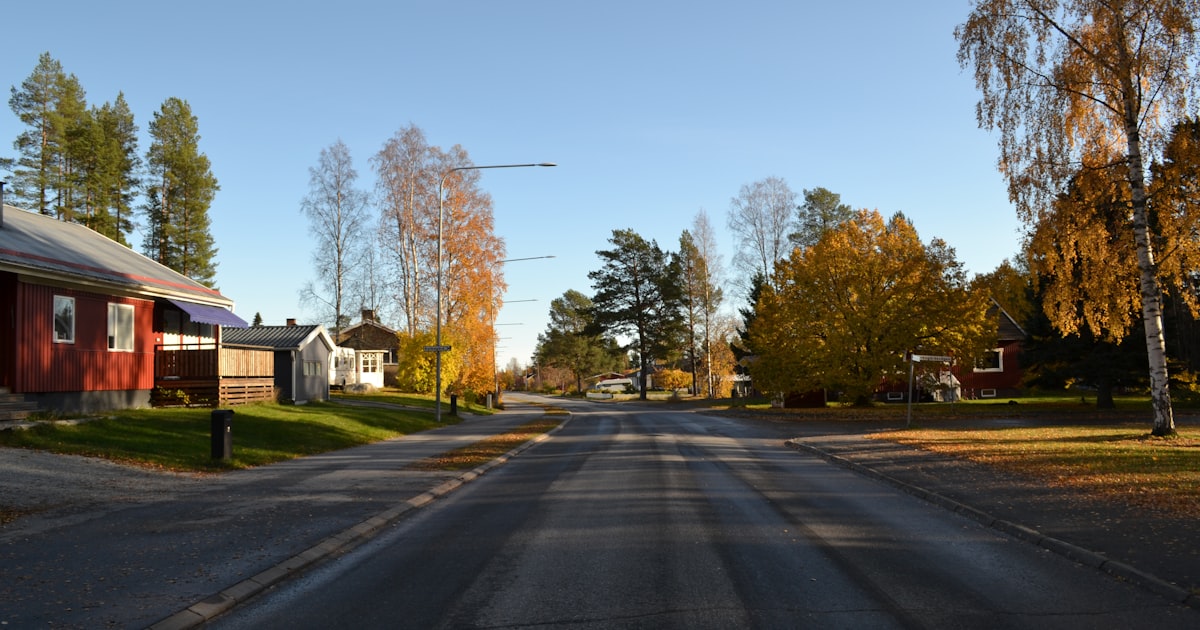
A house at a T-junction, where a street runs straight toward the property, is one of the most discussed problems in feng shui. It is not automatically bad. Severity depends on whether the road truly points at your home, how long and fast the approach is, and how far it stops from your wall. Every version has a workable cure.
If you live at the head of a T, you already know the feeling this article is about. Headlights climb your front wall at night, every approaching car seems aimed at the house until it turns, and street noise arrives head on instead of passing by. Nothing dramatic ever happens, and still the front of the home never quite feels at rest. That experience is real, and it has both a practical explanation and a traditional name.
Why a T-Junction Worries Feng Shui at All
The practical concern comes before any terminology: a home at the top of a T takes headlight sweep across its front wall, carries traffic noise on a direct axis, and sits in the one spot a driver reaches if a turn is missed. It is like working at a desk at the end of a long corridor, everyone walking straight toward you all day. Nothing may ever go wrong, but some part of you keeps track of the approach anyway.
Classical feng shui gives this condition a name, sha qi, often translated as rushing or cutting energy. Roads play the role that rivers played in the older texts. Qi is understood to travel along them the way water travels along a channel, and a long straight channel lets it accelerate instead of meandering and settling. The house standing at the head of the T is the one thing in the way when that current arrives. You will also see this called a poison arrow, the general term for any long straight feature aimed at a home, whether a road, a ridgeline, or the sharp corner of a neighboring building. The classical and practical readings agree here, which is true of more feng shui than people expect, and our plain answer to what feng shui actually is covers how those readings are built. Either way, the right response is measurement first, then a cure sized to what you measured.
Not Every T-Junction House Has the Problem
A T-junction only matters when the centerline of the approaching road, extended forward, actually crosses your house, and the effect fades quickly with distance, angle, and slower traffic. Plenty of homes that appear to sit at a T are fine once you check the geometry, because the road ends slightly offset and its line runs into a side yard or the neighbor's lot.
Five things decide how seriously to take your junction, all visible from a satellite map or your own curb.
The first is the line itself. Extend the centerline of the approaching road straight past the intersection and see what it meets. Crossing the front of your house is the real case, and the one worth treating as a moderate importance issue. Crossing your driveway or a corner of the lot is a minor concern. Missing your property entirely means you do not have a T-junction problem, whatever the street layout looks like.
The second is the length of the straight run. A road needs distance to build the rushing quality the tradition describes. A stub street of 100 feet with three driveways on it carries almost nothing. A straight run of a quarter mile with no bends and few stops is the version the old texts were warning about.
The third is slope. A road that descends toward your house adds speed, in the classical reading of qi and on the speedometer alike. A road that climbs toward you is softer by the same logic.
The fourth is traffic. Ten cars a day on a 25 mph residential stub is a different animal from a collector street moving commuters at 40 mph. The road class, the posted speed, and what you hear at rush hour all count.
The fifth is your setback. The space between the road end and your front wall is the buffer where anything arriving gets slowed and broken up. A house 20 feet from the stop line has a sharper junction than one 60 feet back behind a deep yard.
A Worked Example, With the Numbers
You can score your own T-junction in about ten minutes with a satellite map, its distance tool, and one evening standing at your front door. Here is what that looks like on a plausible house, so you can copy the method.
Picture a home at the head of a T where Birch Street dead-ends into Alder Court. On the satellite view, Birch Street runs almost due north at a bearing of about 4 degrees, straight for 620 feet with no curve. The house fronts Alder Court facing south, with the front wall facing a bearing of about 184 degrees. Since 184 minus 4 is 180, the road points at the facade nearly head on, which is the strongest alignment a T-junction can have. If you do not know your own facade bearing, our free reading works it out from a map so you do not need a compass.
Next, the line. Extending Birch Street's centerline with the map's measuring tool, it crosses the lot boundary and meets the house on the western third of the front wall, about 9 feet from the front door. This is the real case. If that same line had passed 30 feet west, it would have run harmlessly down the property line.
Then the aggravators and the softeners. Elevation along Birch Street drops about 11 feet over the 620 foot run, a grade of just under 2 percent, downhill toward the property. That is an aggravator. Against it, the posted speed is 25 mph, parked cars slow traffic further, and the front wall sits 42 feet back from the curb behind a lawn. Those are softeners.
The verdict on this example: a T-junction condition of moderate importance. The head-on bearing, the 620 foot run, and the downhill grade make it worth curing. The low speed and the 42 foot setback mean the cure can be modest, a pair of shrubs rather than a moving van. That is the honest middle where most T-junction homes land.
The Cures, Ranked
The whole cure for a T-junction is to break, slow, or redirect the straight line before it reaches your front wall. You never need to move the house, only to interrupt the line. Pick by your yard, your budget, and whether you own the property.
Best: put something living on the line
A dense planting placed where the road's extended centerline crosses your front boundary is the strongest cure, because it interrupts the sight line, absorbs headlight sweep, muffles axis noise, and adds a living feature, which feng shui reads as slowing and softening energy rather than merely blocking it. A short hedge section, a pair of dense evergreen shrubs, or one small tree all qualify. The planting does not need to span the frontage, only to cover the line you located on the map.
Cost band: free if you transplant volunteers or take cuttings from a neighbor, under $50 for two one-gallon evergreen shrubs from any garden center. The cure starts working the day you plant and reaches full strength within a few seasons.
Next best: a solid element, gate, fence panel, or trellis
Where planting will not fit, a solid feature on the same line does the same work immediately at full strength. A fence section, a garden wall segment, a closed gate, or a trellis panel you can later grow a vine up all serve. The trellis is the quiet favorite, because it starts as a screen and becomes a living screen.
Cost band: under $50 for a single wooden trellis panel or a prebuilt fence section. If your municipality restricts front-yard fencing height, a 3 foot panel still breaks the low, fast portion of the line, which is the part that matters, headlights and bumpers both travel low.
Backup: deflect at the door
The traditional deflection cure is a small convex mirror mounted above the front door, facing the road, to symbolically turn the arriving energy back along its path. It is the cheapest and fastest option and the right backup when you can alter nothing in the yard. Use a plain convex mirror or a traditional bagua mirror and keep it small. At a T-junction it faces down the road, not at anyone's home, so the usual courtesy concern does not arise.
Cost band: under $30. Pair it with a bright, warm porch light on the same wall, free if the fixture already exists, which the tradition reads as strengthening the entry and which practically makes the house unmistakable to every driver on the approach.
The renter-friendly version
Renters can run the full cure without touching the property. Two large potted evergreens on the step or porch, placed to flank or cover the line, do the work of the planting cure and move out when you do. Inside, a heavy curtain across the front door, kept drawn at night, blocks the headlight sweep and steadies the entry. Both together stay under $50. Since the front door is where a T-junction concentrates, it is worth getting the whole entry right, and our guide to front door feng shui walks through that from the outside in.
If You Are Buying a House at a T-Junction
A T-junction is a negotiating point, not an automatic walk-away, because the fix costs less than a tank of gas and the discount is often real. In buyer terms, classify it as important but fixable. The road itself is permanent, but the exposure it creates can be cured at the property boundary for under $50. Should it stop the purchase? On its own, no. It earns a walk-away only when it stacks with several other site conditions you cannot change.
Run the measurement before you make the offer, not after. Pull up the satellite view, extend the road's centerline, measure the straight run and the setback, and drive the approach once at night to see exactly where the headlights land. Ten minutes turns a vague worry into a number you can price.
Two things belong in your thinking that have nothing to do with energy. First, resale. A meaningful share of buyers will discount or skip a T-junction house on feng shui grounds alone, so expect to give back some of your purchase discount when you sell. Second, the mundane version of the risk, noise on axis and light sweep, is permanent, while the cure for both is the same hedge described above. If you are weighing several homes, this check belongs on the same list as the roof and the furnace, and our checklist for moving into a new home shows where it fits among the rest.
What Not to Worry About
One street layout does not decide a home. If the extended centerline misses your house, if the approach is short and slow, or if a mature hedge already sits on the line, file this issue as minor or already cured and move on. A T-junction also says nothing about the light inside, the layout, or how the home fits the people in it. Treat it as one entry on a longer checklist, never as a verdict on the property.
Check Your Own Address
No single rule should ever be judged alone. A T-junction carries more or less weight depending on the rest of the property, the facing direction, the surroundings, and the people living there. Your house is a specific case, with a real road at a real bearing, a real slope, and real surroundings that no article written for everyone can read for you. Enter your address and we will show you what your home's facing direction, the road geometry, and what is around it actually mean, for the house you live in or the one you are about to make an offer on. The first findings are free.
Frequently asked questions
Is it bad feng shui to live at a T-junction?
Only when the approaching road actually points at the house, and even then the severity varies. A short, slow, offset road is a minor concern or none at all. A long, straight, downhill road aimed at your front wall is the moderate to high importance version, and it is curable with a planting, a screen, or a deflecting element placed on the road's line.
What is a poison arrow in feng shui?
A poison arrow is any long, straight feature aimed directly at a home, most often a road, but also a ridgeline or the sharp corner of a neighboring building. It is read as concentrating fast-moving energy on one spot. The cure is always the same family: block it, soften it, or deflect it before it reaches the wall.
Do bagua mirrors really work for a T-junction house?
A bagua mirror is the traditional deflection cure and the weakest of the three options, which is why it ranks as backup rather than best. It is appropriate when nothing in the yard can change. If you use one, keep it small, mount it above the door facing the road, and never aim it at a neighbor's house.
How far from the road does a house need to be to escape T-junction effects?
There is no single magic distance, but the effect weakens sharply with setback. A front wall within about 25 feet of the road end faces the strong version. Beyond about 60 feet, with a yard, planting, or grade change in between, most practitioners treat the condition as mild, especially when something interrupts the line in that space.
Does a cul-de-sac or a curved dead end count as a T-junction?
No. The defining feature of a T-junction problem is a straight road aimed at the house. A cul-de-sac bulb spreads approaching traffic around a circle, and a curved dead end never builds a straight run. Those layouts raise different feng shui questions, but the poison arrow is not one of them unless a straight segment points at your lot.