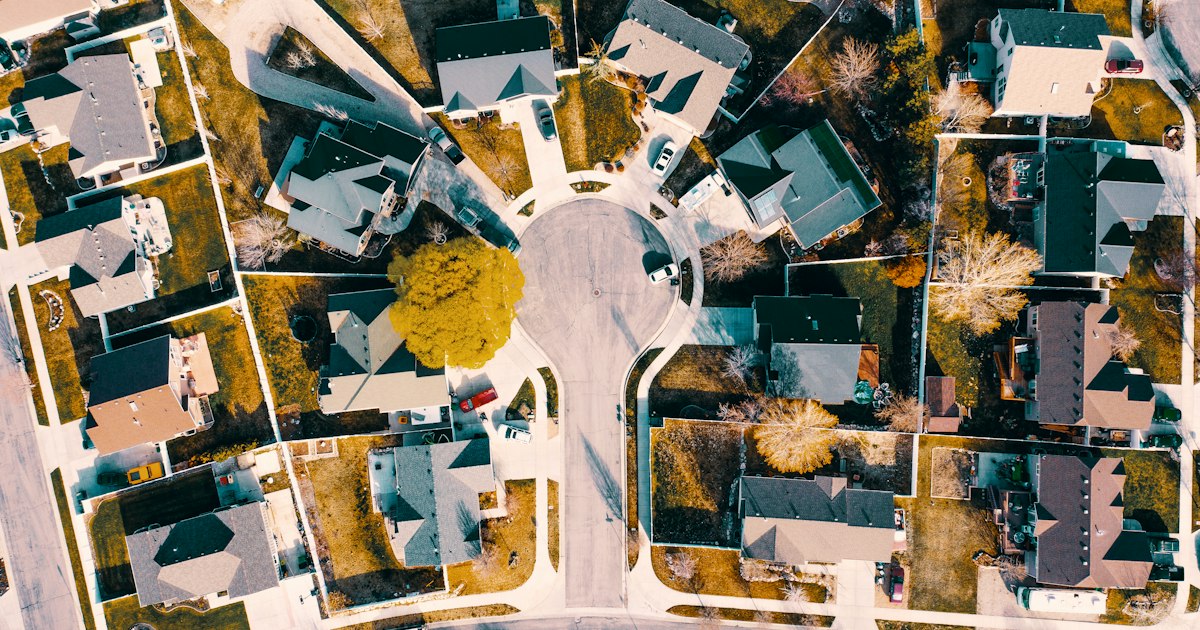
A cul-de-sac is usually considered good feng shui, with one exception. Houses along the curve of the turnaround benefit from quiet, enclosure, and low traffic. The house sitting straight at the head of the road, with the street pointing at its front wall, carries the same concern as a T-junction and deserves a closer look.
What you probably noticed from the curb
Most people who search this have already stood on the street and felt something they could not name. On a cul-de-sac the feeling is usually good. The street goes quiet about halfway in, cars move at walking pace because there is nowhere to hurry to, and the houses seem to face each other instead of facing traffic.
Then there is the other version. You come back at dusk, and while you stand in the front room a car comes up the street and its headlights swing across the window and hold there before the driver turns around. You notice it, and you say nothing, because it sounds like a small thing to raise about a house you otherwise like.
Both observations are real, and feng shui has language for both.
Why a cul-de-sac usually helps
The plain reason first. A road with no through traffic carries a fraction of the cars a connector street carries, and the ones it does carry are slowing down. Less noise, fewer strangers passing the front window, and a front yard that works as usable space rather than a buffer. The turnaround also puts neighbors in view of each other.
Then the traditional layer. Feng shui prefers a home that feels held on three sides with an open view in front, the shape of an armchair. A cul-de-sac often produces something close to that at the neighborhood scale, because houses on the bulb sit in a loose curve with their fronts opening onto shared quiet space. The classical name is the armchair position, meaning support behind and a clear outlook in front.
The everyday version is the difference between a chair with a solid back and a stool with none. You can sit on a stool for an hour, but you settle into the chair.
Importance of this benefit: moderate importance, and genuinely positive. It is one of the few street conditions that tends to help rather than hurt.
The one house worth a second look
Draw the centerline of the straight part of the street and extend it forward. On most cul-de-sacs it lands in the middle of the turnaround pavement or across the corner of a yard. On some, it lands squarely on the front wall of the house at the head of the road.
That case is worth examining, and the reason is physical before it is traditional. A long straight run of pavement pointed at a front wall delivers headlights, engine noise, and whatever the street carries at the same face of the building each time. Traditionally this is called sha qi, sometimes translated as a poison arrow, meaning fast, straight, unbuffered movement aimed at a home rather than curving past it. The useful analogy is a desk at the end of a long corridor. Nothing bad happens in the corridor, but you feel everything that comes down it.
This is normally the mild version of the problem. On a T-junction traffic arrives at speed and does not stop. On a cul-de-sac cars are decelerating, volume is low, and most arrivals are neighbors going home. Same geometry, much smaller dose.
Importance: high importance when the aim is close to square and the setback is short, minor concern when the road is offset or the front is well screened.
A worked example on one house
Larkspur Court leaves Willow Road heading 006 degrees, close to due north, and runs straight for 240 feet before opening into a bulb roughly 76 feet across. Three houses sit on it.
House A sits at the head of the court, front wall facing 186 degrees, looking straight back down the road. The road bearing sits 6 degrees off the perpendicular of that wall, which is effectively square. The extended centerline passes 9 feet to the left of the front door, and the wall is 34 feet back from the pavement edge. A rough working rule: if the extended centerline passes within about 15 feet of the front door and the setback is under about 40 feet, treat the house as aimed at, then look at what stands between road and wall. Here, nothing does. Lawn only. This is the one to address.
House B sits on the west side of the bulb, front wall facing 264 degrees. The road centerline crosses its frontage at 78 degrees off perpendicular, so the street runs across its view rather than at it, and the extended centerline misses the house entirely. Cars turning in the bulb sweep its windows at night, but the sustained straight-line exposure is not there. This one is fine, and it gets the quiet.
House C sits on the east side, set back 48 feet with two mature maples between pavement and front wall, so it has House B geometry plus a screen already in place. Nothing to do.
Three houses, one street, three readings. That is the part a general rule cannot give you.
Dead-end streets without a turnaround
A true dead end, where the pavement stops at a barrier or property line with no bulb, reads slightly differently. There is no circle for cars to slow into, so drivers arrive, brake, and reverse. Headlight sweep tends to be worse, and the house at the terminus takes the full length of road as a channel with no curve to soften it.
There is also a practical point a home inspector would agree with. One point of entry and exit means a single blockage, whether a delivery truck, snow, or a downed limb, affects everyone on the street. Ask where the snow gets pushed, because on a dead end it usually goes to the end.
Importance: moderate importance. Worse than a bulb cul-de-sac, better than a busy T-junction.
The stale air concern, and what it really is
Traditional texts describe a dead end as a place where energy enters and has nowhere to go, so it settles rather than circulates. Stripped of the terminology there is a small physical version. Airflow is lower where there is no through route, and leaves, grit, and standing water collect at the closed end.
None of that will harm anyone. It is a maintenance and drainage question rather than a fate question, and it is worth ten minutes at a viewing. Look at the curb line and the storm drain at the closed end and see whether the street keeps it clear.
Importance: minor concern, and largely under your control.
Lot shape on a cul-de-sac
Cul-de-sac lots are commonly pie shaped, narrow at the street and wide at the back, and people worry because the frontage looks small.
In traditional terms this is the favorable shape. A plot narrower at the entrance and wider at the rear is compared to a money bag, meaning it gathers rather than spills. The reverse, wide at the street and pinching to a narrow rear, is viewed less kindly. In practice a pie lot gives you a deep private back yard and a modest front, which most families prefer.
The exception is a lot squeezed so tightly at the street that the driveway is steep, awkwardly angled, or too narrow for two cars to pass. That is a daily-life problem rather than a traditional one, and it is worth walking before you commit.
Importance: mostly traditional for the shape itself, moderate importance for a driveway that does not work.
Headlights, the thing nobody mentions
This comes up after move-in and almost never at a viewing, because viewings happen in daylight. Every car reaching the end has to rotate, and the beams travel across whatever faces the bulb. If the room you use in the evening faces the turnaround, you will register it.
The feng shui framing is repeated disturbance to a place of rest, not danger. The version everyone recognizes is the restaurant seat with your back to the entrance. Nothing is wrong, and you still keep glancing over your shoulder.
Importance: depends on the person. Some people never notice. Light sleepers and anyone whose desk or sofa faces the bulb notice within a week.
If you are buying
Every condition here is a property feature, so here is the verdict.
| What you are looking at | Classification | Should it stop the purchase? |
|---|---|---|
| House on the curve of the bulb | Minor, and mostly a benefit | No |
| House at the head, road aimed square at the front, no screening | Important but fixable | No. Budget a screening plan and negotiate normally |
| Terminus of a straight dead end with no bulb | Important but fixable, sometimes context-dependent | Rarely. Weigh it with the rest of the property |
| Pie-shaped lot | Minor, traditionally favorable | No |
| Headlight sweep into a main living room | Temporary in effect, fixable | No |
| Steep or cramped driveway | Important and permanent | Possibly, if it does not work for your cars |
| Debris or poor drainage at the closed end | Temporary | No |
The short answer for buyers is that a cul-de-sac is one of the street types least likely to be a reason to walk away. Road geometry at the head of the bulb is worth pricing in, not worth losing the house over, and the only truly permanent item on that list is a driveway that cannot be regraded.
What to do about it, in order
For the aimed house, and for headlight sweep.
Best. Break the line of sight between road and front wall with something solid and slightly off center, so it interrupts the line without blocking your own view or your front entrance. Two or three staggered shrubs, or one small tree offset from the door, do more than a single centered object. Free if you can move a shrub or large planter you already own, otherwise under $50 for a nursery shrub in a heavy pot. Renter friendly, because a potted screen moves with you.
Next best. Manage the light rather than the road. A blackout-lined curtain panel or a cellular shade on the window facing the turnaround removes the sweep after dark. Under $30 for a panel and a tension rod, renter friendly with no drilling.
Backup. Change how you occupy the front-facing room. Turn the seat you rest in so your back is not to the window facing the bulb, and put a warm lamp on a dusk timer near the front so the entrance reads as settled rather than exposed. Free for the furniture change, under $30 for the timer.
For the stale end of the street the order is simpler. Keep the curb line and storm drain clear, which is free. Air the house across two sides for ten minutes a day, also free. If the closed end is dark, a solar path light at under $30 does more for how the street reads than any traditional object.
What not to worry about
Living on a cul-de-sac is not a problem you need to solve. If your house sits on the curve of the bulb, you are on one of the better street types available, and there is nothing here to fix.
You do not need a mirror aimed at the road, a decorative cannon, or any object sold as a cure for road energy. The working part of every remedy above is a physical interruption of a sightline, or a change in how a room gets used.
One aimed front wall does not make a house a bad house. If the rest of the property has support behind it and a clear, well-lit entrance, that wall is a screening project rather than a verdict. If the framework behind all of this is new to you, the plain-English overview explains why these rules tend to describe physical comfort rather than luck.
One street rule never decides a house
No single rule should be judged on its own. The weight of a cul-de-sac position depends on the rest of the property, what surrounds it, which way the building faces, and who lives there. The same head-of-the-bulb house can read as slightly exposed for one family and as settled for another. Your Kua number is one part of that personal side, and it says nothing about the road until the two are read together.
Enter your address and we will show you what your home's facing direction, the road geometry around it, and what sits nearby actually mean for your property rather than for cul-de-sacs in general. If you are weighing an offer, check the address before you write it, and see whether what you noticed at the viewing is permanent, temporary, or fixable. The first findings are free.
Frequently asked questions
Is a cul-de-sac good or bad feng shui?
Usually good. Low traffic, a sense of enclosure, and neighbors in view of each other are all conditions feng shui treats as supportive. The exception is a house at the head of the road with the street pointed at its front wall, which is worth screening.
Is the house at the end of a cul-de-sac bad feng shui?
Not automatically. It depends on whether the straight run of the road aims at the front of the house or passes to one side, and on whether anything stands between pavement and front wall. A house at the end with mature planting in front reads very differently from one with open lawn.
Is a dead-end street worse than a cul-de-sac?
Slightly, yes. Without a turnaround, cars stop and reverse at the end, headlight sweep is stronger, and debris tends to collect there. The difference is one of degree, not a different category of problem.
Which house on a cul-de-sac is the best one?
Usually a house on the curve of the bulb, set back far enough that the straight run of the road does not point at its front wall, with something growing between the pavement and the house. That combination gives you the quiet without the aim.
Should a cul-de-sac position stop me from buying a house?
Almost never. The only element that cannot be changed is a driveway that does not physically work for your vehicles. Road aim, headlight sweep, and drainage at the closed end are all fixable, most for under fifty dollars, and none require renovation or work against a rental.